
Table of content

Introduction
Most of what we think we know about how a colleague works comes from impressions: how they came across in a meeting, how they handled one stressful week, how they interview. Useful, but inconsistent and easy to get wrong. A psychometric assessment replaces the impression with a measurement, a structured, validated way of describing how a person thinks, communicates and makes decisions, so the picture is the same whoever is reading it.
This guide explains what a psychometric assessment actually is, what it measures and what it does not, how it differs from the free personality quizzes it is often confused with, and how the PRISM Brain Map applies it for individuals, teams and coaches.
Key Takeaways
- A psychometric assessment is a standardised, validated questionnaire that measures how a person thinks, communicates and behaves, interpreted against a comparison group so results are consistent across people.
- It is not the same as a free online personality quiz: the difference is validation, reporting depth, and professional use, not length
- A behavioural assessment produces a profile, not a score to rank or pass people on. There is no “wrong” profile.
- The PRISM Brain Map is a behavioural assessment measuring preference across eight behavioural dimensions, producing three views of a person: Underlying, Adapted and Consistent.
- PRISM Brain Map is a behavioural questionnaire, not a medical or brain-scanning test. There is no scan, no equipment and no diagnostic claim.
What Is a Psychometric Assessment?
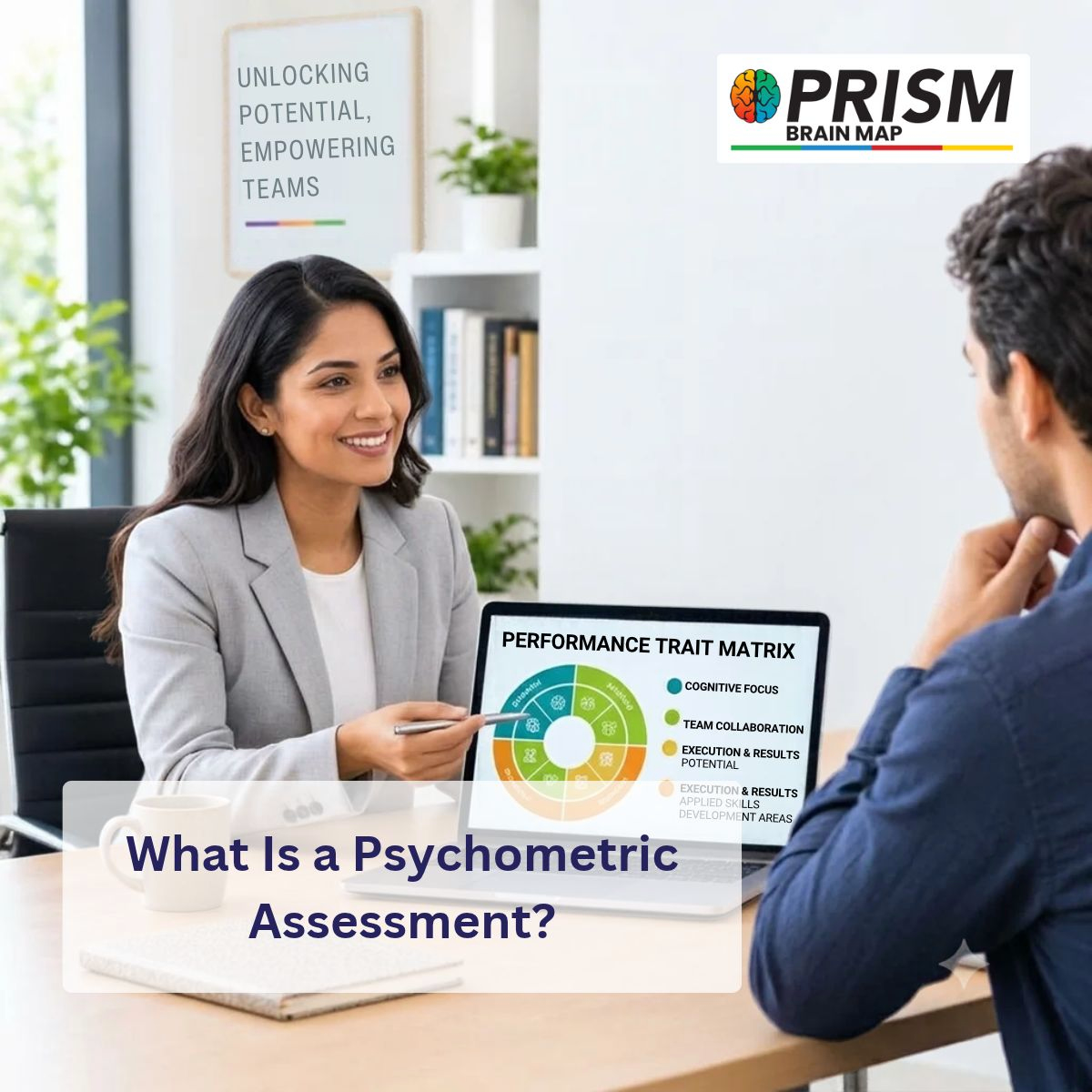
A psychometric assessment is a standardised, validated questionnaire used to measure how a person typically thinks, communicates, makes decisions and responds to pressure. Every respondent answers the same items under the same conditions, and the results are interpreted against a comparison group, which is what makes the output consistent and comparable in a way that a conversation or an observation is not.
The word “psychometric” simply means measurement of the mind. It is not a scan, a screening or a medical procedure of any kind.
Broadly, assessments used in professional settings fall into three families:
- Ability and aptitude tests measure what a person can do right now, such as numerical, verbal or logical reasoning. They are timed, they have correct answers, and they produce a score.
- Behavioural and personality assessments measure how a person prefers to work. There are no right answers and no score to rank people by. What you get is a profile. The PRISM Brain Map sits here.
- Emotional intelligence assessments measure self-awareness, self-regulation and how accurately a person reads and responds to others.
What makes any of these a genuine psychometric assessment rather than a questionnaire with a nice chart is evidence. The British Psychological Society’s Psychological Testing Centre sets out the reliability and validity standards a properly constructed instrument is expected to meet. If a provider cannot show that evidence, you have a quiz, not an assessment.
Psychometric Assessment vs Personlity Test: What Is the Difference?
The two get used interchangeably, but they are not the same thing, and the difference matters the moment a real decision rests on the result.
| Free online personality quiz | Validated psychometric assessment | |
|---|---|---|
| Purpose | Curiosity, entertainment | Hiring, development, coaching, team design |
| Validation | Usually none | Published reliability and validity evidence |
| Output | A type label or a short result | A full report interpreted against a norm group |
| Interpretation | Self-read | Read by a trained or accredited practitioner |
| Repeatability | Varies each time | Consistent and comparable across people |
A free quiz tells you something you can take or leave. A validated psychometric assessment produces a report that is defensible enough to inform a decision affecting someone’s job, which is exactly why the standards around it are higher. This is also why high search volume for terms like “personality test” does not mean high value: most of that traffic is curiosity, not people making professional decisions.
What Does the PRISM Brain Map Measure?
The PRISM Brain Map is a behavioural assessment built on applied neuroscience research. Rather than sorting people into a single type, it measures preference across eight behavioural dimensions and produces three distinct views of the same person:
- The Underlying Map – natural, instinctive behavioural preference.
- The Adapted Map – how the person modifies their behaviour to meet the demands of their current role or situation.
- The Consistent Map – the behaviour that holds steady across both.
That three-map structure is the part a single-label personality quiz cannot reproduce. Seeing the gap between how someone naturally prefers to work and how they are currently behaving is far more useful than a fixed type, because it shows where a person is stretching, and a stretch that is sustainable for a month is not always sustainable for a year.
You can read more about what PRISM measures and the science behind PRISM.
An Important Clarification
PRISM Brain Map is a behavioural questionnaire, not a medical or clinical instrument. There is no brain scan, no electrode, no equipment and no diagnostic claim of any kind. The word “map” describes a behavioural profile, nothing more. This is worth stating plainly, because “brain mapping” is also used in clinical settings to describe something entirely different.
On the research foundation behind that behavioural model, Professor Karl H. Pribram, emeritus professor of psychology and psychiatry, has written:
“The creators of the PRISM behavior profiling tool have made commendable use of the fact that the brain is a dynamic organ and can change its physical structure throughout life. As a result, it is possible to change patterns of thinking and behaving, and to develop new mindsets, skills, and abilities.”
Reproduced with permission of PRISM Brain Mapping UK LLP
What a Psychometric Assessment Cannot Tell You
Being clear about the limits is what separates organisations that get value from assessment from organisations that get complaints about it. A psychometric assessment will not tell you:
- Whether a person is motivated on a particular day.
- Technical skill you have not separately assessed.
- Cultural fit as a yes-or-no verdict.
- Whether someone is “good” or “bad”, there is no such profile.
A behavioural profile tells you how a person is likely to work. It does not make the decision for you. In hiring, coaching or team design alike, the profile is an input that makes a human judgement better informed, never a verdict that replaces it.
How Organisations and Individuals Use Psychometric Assessments
The same underlying assessment supports very different jobs depending on who is using it.
For recruitment and selection.
Used at shortlist stage, before the final interview, a behavioural assessment turns a generic interview into an evidence-led one and gives the new manager a head start on day one. We cover this in depth in our guide to using a psychometric test for recruitment.
For corporate training programs and teams.
A shared behavioural language gives a team an evidence-based way to talk about working style, communication and collaboration, rather than relying on generic icebreakers. It underpins stronger team development, leadership development and smart talent onboarding.
For coaching and individual development.
For a coach, a validated assessment is a structured starting point that surfaces patterns a client cannot easily see on their own, and gives the engagement a common reference point. It supports personalised coaching and development, and individuals can begin with their own self-awareness assessment.
Why this matters more now than it used to: the World Economic Forum’s Future of Jobs Report 2025 found employers expect 39% of workers’ existing skill sets to be transformed or outdated between 2025 and 2030. When the specific skills keep moving, how a person learns, adapts and works with others becomes as important as what they already know, and that is what a behavioural assessment measures.
Using a Psychometric Assessment Well
Whatever the use case, the same principles separate a useful assessment from a misused one:
- Use validated instruments. Ask any provider for reliability and validity evidence and for the norm group results are compared against.
- Never treat a behavioural profile as a pass or fail. There is no wrong profile, only different working styles.
- Have results interpreted by someone trained. A trained reader will tell you what a report does not support, which is the part an untrained reader skips.
- Share results with the person assessed. It costs nothing and is the most reliable way to make assessment feel fair rather than extractive.
- Handle the data properly. Assessment results are personal data; collect them for a clear purpose, with consent, and keep them only as long as you need them.
Bringing the Capability In-House
Organisations and consultants who use assessment regularly usually reach a point where routing every report through an external provider stops making sense. The alternative is to get accredited to administer and interpret PRISM directly, which also opens the instrument up for team development, leadership, coaching and succession planning, not only one use case.
No prior assessment experience is required to enter the programme. More than 350 Accredited PRISM Practitioners have been trained in India to date, delivering over 10,000 PRISM Maps. If that is a direction you are considering, our full guide covers how to become a certified PRISM practitioner.
PRISM Brain Map India is the Official Master Distributor for PRISM Brain Mapping Worldwide, based in Kent, United Kingdom, across India and Sri Lanka, and also works with clients in Indonesia and Malaysia on a tailored basis. PRISM has been in use in India since 2009. PRISM Brain Mapping® is a registered trade mark of The Center for Applied Neuroscience.
Frequently Asked Questions
Trusted by some of the biggest brands









Email [email protected], contact PRISM Brain Map India →, or fill out the form below, and we will walk you through a sample PRISM Brain Map report.